

THE GARMENT DYE PROCESS
Crafted here on Wurundjeri Land, only a few kilometres from our store, each piece in our latest collection "Close to Home" is garment dyed locally in small batches. It is a considered process that feels slow, hands on, and deeply connected to the place we live and work on.
Upstairs in our factory office sits a shelf of vintage books that have lived there longer than most of us. Worn in covers. Sun faded pages. Books that cutters and machinists used to flick through on their lunch breaks. These became the inspiration for the palette you see today.
Alongside them, the native plants around us shaped the tones we wanted to capture. Calistemon reds. Manna Gum greens. The cool blue of Blueberry Ash fruit. And the soft golden warmth of Acacia.
This is what goes into the making of each colour.
WHAT IS GARMENT DYEING
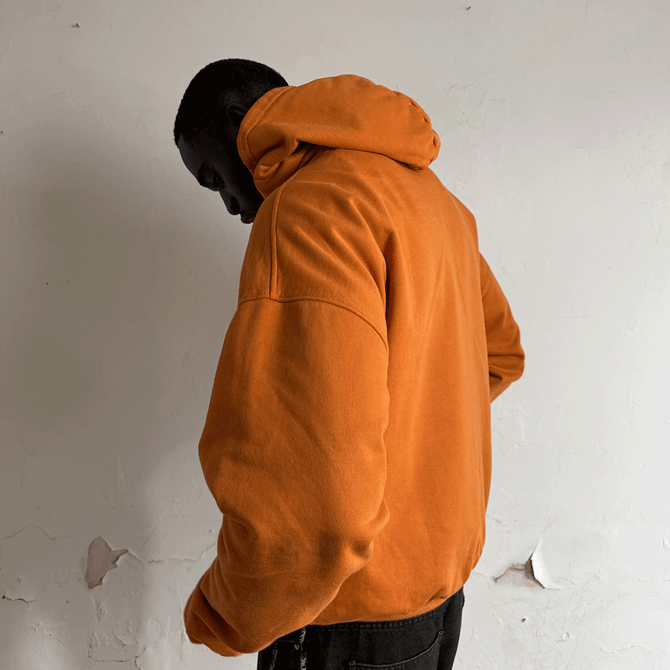
Instead of dyeing fabric rolls before cutting and sewing, garment dyeing happens at the end, once the garment is fully constructed. Our hoodies are knitted, cut, and sewn locally here in Naarm before being taken to our nearby dyehouse for the colouring stage.
Dyeing a finished garment allows for a softer, more lived in finish. The colour settles into the fabric with a gentle, vintage, washed down feel, creating natural depth and slight tonal variation that makes every piece feel personal. No two batches are ever exactly the same, which is part of the beauty of small run, local production.
HOW WE CREATE EACH SHADE
Each colour begins with a reference item. For this collection, we handed our vintage book selection to the dyehouse team. From there, the process looks like this:
-
A scientific dye formulation is developed to match the precise tones of the reference.
-
Small test dips are created and visually compared under both natural and controlled lighting.
-
Adjustments are made to the formulation to fine tune the depth, saturation and undertone.
-
Once approved, our blank hoodies are loaded into the industrial dye drums.
-
The garments are dyed, washed, softened and dried.
-
Each hoodie is pressed, checked for consistency and finished by hand.
This method allows colour to take differently across seams, ribs and panels, creating the subtle character that makes garment dyeing so distinctive.
THE NATURE OF GARMENT DYE
Garment dyeing is an exact science and an unpredictable art. Even with meticulously controlled formulations, the final colour is influenced by environmental factors beyond human control. Rainfall, changes in temperature, and the mineral composition of the dyehouse water tanks can all subtly affect the outcome. In periods of heavy rain, for example, mineral dilution can shift a colour’s warmth or depth by a noticeable margin.
These variables are part of the reality of working with water based dye systems. Achieving an identical shade every single time is technically near impossible. And maybe that is the charm. We are conditioned to expect uniformity, but garment dyeing celebrates natural variance. Each piece absorbs the dye differently. Each batch tells its own quiet story.
Your hoodie will never be truly identical to another. It is a one of one piece made here in Australia, shaped by the land, the weather, the water and the hands that crafted it. This is the opposite of mass production. It is small batch colour made honestly, with character and integrity.
WHY WE DO IT
Garment dyeing allows us to create colours that genuinely reflect the world around us. The plants, books, tones and textures found across Naarm and the Country we live on inform every shade. From the deep red of Calistemon to the soft greens and muted blues drawn from native trees and their fruit, these colours are born from here.
It also means our production remains local from end to end. By working with a close by dyehouse, we close the loop and ensure our garments are wholly made within a small radius. It supports local trades, keeps decades old skills alive and helps us maintain the low impact making that matters deeply to us.
SMALL BATCH, SLOW COLOUR
Because garment dyeing happens in small runs, slight variations between garments and batches are normal. They are not faults. They are the sign of a genuine craft process carried out by local makers, using water, heat and time to bring colour to life.
We hope these new shades feel close to home for you too. Crafted slowly, inspired by the land we live and work on, and coloured through a process shaped by the land and the skilled people who make it possible.


